

Corporate leadership training programs are structured learning initiatives designed to develop strategic thinking, emotional intelligence, and management capabilities in current and aspiring executives. These programs range from intensive in-person workshops to virtual cohorts, often delivered by established providers like Harvard Business School, Center for Creative Leadership, Dale Carnegie, and IMD. For L&D professionals evaluating options in 2026, the decision typically hinges on three factors: the delivery format (in-person versus virtual), the curriculum focus (strategic leadership versus emotional intelligence), and how well the program aligns with your organization’s specific leadership gaps.
The market has evolved substantially. What began as occasional executive retreats has grown into a sophisticated ecosystem of personalized mentoring, action-based learning, and highly interactive virtual classrooms. The Center for Creative Leadership, for instance, offers its flagship Leadership Development Program (LDP) in a live online format specifically designed for mid-level and frontline leaders, while providers like Kellogg Executive Education and FranklinCovey take different approaches to experiential learning and coaching.
For eLearning decision-makers, the challenge isn’t finding a program but identifying which model will produce measurable behavior change in your leaders. The most effective programs blend digital learning with hands-on application, allowing participants to test new frameworks in real organizational contexts. This guide walks through how these programs are structured, what differentiates the major providers, and the practical criteria you should use when building your evaluation matrix.
Understanding Corporate Leadership Training Programs
Corporate leadership training programs are structured learning initiatives designed to develop the capabilities of individuals who manage teams, drive organizational strategy, and shape company culture. These programs target participants across the leadership spectrum, from frontline supervisors managing their first teams to senior executives steering entire business units. The core objective is to build competencies that directly impact organizational performance: strategic thinking, decision-making under uncertainty, team development, and the ability to execute business priorities effectively.
Unlike general professional development, which might focus on technical skills or job-specific knowledge, leadership training addresses the unique challenges of managing people and influencing outcomes through others. A software engineer learning a new programming language is developing professionally; that same engineer learning how to coach struggling team members, delegate effectively, and align her team’s work with broader company goals is developing as a leader. The distinction matters because leadership capabilities transfer across roles and industries in ways that technical skills often don’t.
Organizations invest in these programs to address performance gaps that pure technical training can’t fix. When promising individual contributors struggle after promotion, when mid-level managers can’t develop their teams, or when executives fail to drive cross-functional alignment, leadership development becomes the intervention. The programs work by teaching frameworks for complex people challenges, providing practice in safe environments, and offering feedback that most leaders don’t get in daily work.
The scope varies by target audience. Frontline leadership programs might emphasize foundational management skills like giving feedback and running effective meetings. Executive programs focus on enterprise strategy, organizational change, and stakeholder management. This segmentation reflects the reality that a new manager and a C-suite executive face fundamentally different leadership challenges, even if both need strong people skills.
How Leadership Development Programs Are Structured
Training Content Focus Areas
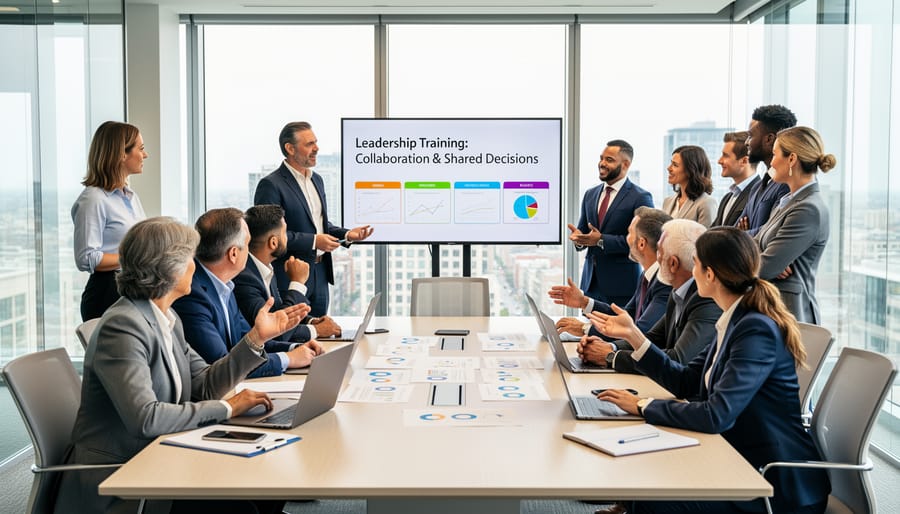
Leadership training programs concentrate their curriculum around two dominant content pillars: strategic leadership and emotional intelligence. These focus areas reflect the dual demands organizations place on leaders, driving business outcomes while managing the human dynamics that make execution possible.
- Strategic Leadership
- The capacity to align organizational vision with operational decisions, allocate resources effectively, and navigate competitive environments. Strategic leadership training covers long-term planning, change management, competitive analysis, and how to translate organizational goals into actionable team priorities.
- Emotional Intelligence
- The ability to recognize and manage one’s own emotions while reading and influencing the emotional states of others. This competency encompasses self-awareness, empathy, relationship management, and the interpersonal skills that enable leaders to build trust, resolve conflict, and motivate diverse teams.
Organizations prioritize strategic leadership content because leaders at every level must connect daily work to broader business objectives. A mid-level manager who understands competitive positioning and resource constraints makes smarter decisions about project scope and team allocation. Executive leadership programs deepen this focus, adding scenario planning and enterprise-level risk assessment.
The emphasis on emotional intelligence and self-awareness stems from research linking these competencies to team performance, retention, and organizational culture. Leaders who lack emotional intelligence struggle with turnover, communication breakdowns, and resistance to change, regardless of their strategic acumen. Most programs now integrate both pillars, recognizing that effective leadership requires technical business judgment and the interpersonal skills to mobilize people around a shared direction.
Training Methods and Learning Approaches
Leadership programs deploy five primary training methods, each serving distinct learning objectives and organizational needs.
In-person workshops and seminars remain foundational for intensive skill-building. These sessions bring participants together for focused instruction on specific competencies, strategic thinking, conflict resolution, change management, through case studies, group exercises, and facilitated discussions. The face-to-face format enables immediate feedback and peer learning but requires travel and time away from daily responsibilities.
Digital learning through online courses offers flexibility and scale. Organizations can deliver core leadership concepts through asynchronous modules that participants complete at their own pace, or through structured virtual programs. This method suits geographically distributed teams and allows learners to revisit materials as needed.
Personalized mentoring and coaching provides one-on-one development tailored to individual leaders. A mentor or executive coach works directly with the participant to address specific challenges, refine decision-making approaches, and accelerate growth in targeted competencies. This method delivers customized support but requires significant resource investment per participant.
Hands-on experiential learning immerses participants in simulations, role-playing scenarios, and business case competitions. Leaders practice applying concepts in controlled environments that mirror real workplace situations, building confidence and revealing gaps before high-stakes decisions.
Action-based learning embeds development into actual work projects. Participants tackle genuine organizational challenges while receiving coaching and applying newly learned frameworks, creating immediate business value alongside skill development.
Most effective programs blend multiple methods rather than relying on a single approach. A mid-level leadership program might combine online pre-work, intensive in-person workshops, ongoing coaching sessions, and team-based action learning projects, leveraging each method’s strengths to reinforce concepts and drive behavioral change.
Delivery Formats: In-Person vs. Virtual Training
Leadership training programs today split into two primary delivery streams: in-person sessions and virtual formats, each offering distinct advantages for different organizational needs and learning contexts.
In-person training brings participants together in physical classrooms or off-site venues. These sessions excel at building peer networks through face-to-face interaction and allow facilitators to read body language and adjust content dynamically. Organizations typically choose in-person formats for executive-level programs where relationship-building matters as much as skill development, or when they want to create an immersive experience away from daily work distractions.
Virtual training has moved far beyond basic webinars. Modern online programs now incorporate real-time interaction through breakout sessions, collaborative exercises, and discussion forums that maintain engagement comparable to physical classrooms. The Center for Creative Leadership delivers its virtual programs in a highly interactive online classroom format, demonstrating how digital platforms can replicate the collaborative elements of in-person learning while adding scheduling flexibility.
| Characteristic | In-Person Training | Virtual Training |
|---|---|---|
| Interaction Style | Face-to-face, immediate body language feedback | Screen-based with chat, video, and digital collaboration tools |
| Scheduling Flexibility | Requires travel and consecutive days off-site | Often spread across weeks in shorter sessions |
| Typical Use Cases | Executive programs, intensive retreats, team-building focus | Mid-level and frontline leaders, geographically dispersed teams |
| Technology Requirements | Minimal beyond presentation equipment | Reliable internet, LMS video conferencing collaboration platforms |
The choice between formats depends on your specific constraints. Virtual works well when you need to train leaders across multiple locations without travel costs, or when schedules make multi-day absences impractical. In-person remains valuable for senior leadership cohorts where relationship depth matters, or when the program design requires extended immersion away from workplace interruptions. Many organizations now adopt hybrid models, combining virtual instruction with periodic in-person sessions for relationship-building milestones.
Major Providers and Program Examples

Center for Creative Leadership Programs
Center for Creative Leadership has positioned itself as a specialist provider of virtual leadership development, particularly for mid-level and frontline leaders. Their online portfolio spans several formats, from self-paced courses to structured development programs delivered through what CCL calls a “highly interactive online classroom format.”
The flagship offering is the Leadership Development Program (LDP)®, which targets mid-level leaders navigating the transition to greater responsibility. This program focuses on developing the strategic and interpersonal capabilities needed at that career stage, though CCL structures the curriculum around participant needs rather than a single fixed model.
CCL’s virtual programs address both of the market’s dominant content focus areas: strategic leadership and emotional intelligence. Their online delivery model aims to replicate the engagement of in-person workshops through live facilitation, small cohort structures, and real-time interaction among participants. This approach reflects the broader shift toward virtual training that maintains the collaborative elements organizations value in traditional programs.
The target audience for CCL’s virtual solutions skews toward mid-level and frontline leaders rather than C-suite executives. This positioning addresses a gap in many organizations’ development pipelines, where emerging leaders often receive less structured training than senior executives. CCL’s programs combine personalized coaching, experiential learning activities, and digital course components, blending multiple training methods within a single program structure rather than relying on lectures alone.
Selecting the Right Program for Your Organization

Choosing a leadership development program starts with defining what you need it to accomplish. Align the program’s learning objectives with specific organizational challenges, whether you’re building strategic thinking skills across mid-level management, developing emotional intelligence in frontline leaders, or preparing high-potentials for executive roles. A program that promises broad leadership competencies without connecting to your context rarely delivers measurable impact.
Match the program to your target audience’s leadership level. Programs designed for mid-level leaders emphasize different competencies than those built for executives or frontline supervisors. CCL’s virtual leadership development programs, for example, explicitly target mid-level and frontline leaders rather than taking a one-size-fits-all approach. This segmentation matters because leadership challenges differ substantially between levels.
Evaluate delivery formats based on your learners’ needs and organizational constraints. In-person workshops offer intensive face-to-face interaction but require travel and time away from work. Virtual training provides flexibility and typically better cost efficiency, though effectiveness depends on program design. Look for virtual programs that maintain high interactivity rather than simply delivering video lectures, CCL’s highly interactive online classroom format demonstrates how digital delivery can support active learning rather than passive consumption.
Examine the training methods the program employs. Strong programs blend multiple approaches: digital learning combined with personalized coaching, or experiential exercises paired with mentoring. Programs relying solely on one method, whether online courses or in-person seminars, limit how participants can practice and apply new skills. Consider whether the design reflects how learning works through application and reinforcement, not just content delivery.
Assess the provider’s track record with organizations similar to yours. Ask for concrete examples of program outcomes, participant feedback, and whether they incorporate completion rate best practices into their design. Vendors should demonstrate how they measure learning transfer and business impact beyond completion certificates. Be wary of providers who can’t articulate clear success metrics or show evidence of iterating their programs based on participant results.
Common Questions About Corporate Leadership Training
How do corporate leadership training programs differ from MBA programs?
Leadership training programs focus specifically on developing leadership competencies and practical skills for immediate application, while MBA programs provide broader business education covering finance, marketing, operations, and strategy. Leadership programs typically require weeks or months versus the two-year commitment of most MBA programs, and they target working professionals seeking skill development rather than a graduate degree.
How long do typical leadership development programs last?
Program duration varies widely based on delivery format and depth. Intensive in-person workshops may run three to five days, while comprehensive development programs stretch across several months with periodic sessions. Virtual programs often use modular formats spanning eight to twelve weeks, allowing participants to balance learning with their ongoing work responsibilities.
Are virtual leadership training formats as effective as in-person programs?
Virtual programs can match in-person effectiveness when designed with high interaction levels and structured application activities. Providers like CCL deliver virtual training in highly interactive online classroom formats that maintain engagement and peer learning opportunities. The key differentiator is program design quality rather than delivery mode, poorly designed programs underperform regardless of format.
How can organizations measure ROI from leadership training investments?
Effective measurement combines behavioral change indicators with business outcomes. Track participant application of learned skills, changes in team performance metrics, employee retention rates among participants’ direct reports, and promotion readiness assessments. Organizations should also evaluate information retrieval at work to understand how leaders access and apply training content after program completion.
When deciding who should participate in leadership training, consider both current role requirements and future leadership pipeline needs. Programs targeting strategic leadership competencies suit senior and mid-level leaders making organizational decisions, while emotional intelligence-focused training benefits frontline managers building team relationships. Most organizations achieve best results by segmenting participants by leadership level rather than mixing executives with first-time managers, since each group faces distinct challenges requiring different skill emphases.
Corporate leadership training programs remain a vital investment for organizations committed to building capable, adaptive leaders at every level. The landscape in 2026 reflects a maturing market where providers have refined their approaches to meet diverse organizational needs, with virtual and hybrid formats now standing alongside traditional in-person delivery as credible, effective options.
For eLearning professionals evaluating programs, the key is moving beyond surface-level comparisons. The most successful implementations start with clarity about what your organization actually needs: Are you developing frontline leaders who need practical management skills, or executive teams requiring strategic thinking capabilities? Does your culture benefit more from the intensive focus of in-person workshops, or does your distributed workforce require the accessibility of virtual delivery? Is emotional intelligence your priority, or do you need leaders who can navigate complex strategic challenges?
The providers profiled throughout this article, from CCL’s virtual programs for mid-level leaders to Harvard Business School’s executive education offerings, demonstrate that quality leadership development comes in many forms. There is no universal best program, only the best fit for your specific organizational context, leadership gaps, and learning culture. Approach vendor evaluation with your strategic goals clearly defined, and you will find programs that deliver genuine leadership capability rather than just checking a development box.