

Selecting the right instructional method starts with understanding your learners’ needs, your content objectives, and the constraints of your delivery environment. The most effective approach combines a core teaching strategy (such as direct instruction, collaborative learning, or problem-based learning) with assessment checkpoints that confirm learners are progressing toward measurable outcomes. This process typically requires 2-4 hours of upfront analysis and design time per hour of instruction, but that investment directly determines whether your training creates lasting behavior change or simply checks a compliance box.
The conversation around instructional methods has shifted considerably as we approach World Teachers’ Day on October 5, 2026. Recent professional development events, including the Beginning Teachers’ Conference in Calgary that wrapped up on October 3, have highlighted how educators and corporate trainers are moving beyond one-size-fits-all delivery models. The sessions there, from foundational workshops to advanced topics, demonstrated that choosing an instructional method is less about following trends and more about matching technique to context.
What separates high-performing learning programs from mediocre ones is intentional method selection. When you choose direct instruction for procedural skills, case-based learning for decision-making competencies, or simulations for high-risk scenarios, you’re making a strategic decision about how information will transfer from short-term exposure to long-term application. Each method carries specific requirements for facilitator skill, technology infrastructure, and learner readiness. Missteps in this selection process show up months later when performance metrics reveal that learners completed the training but can’t apply the skills.
This guide walks you through a decision framework for matching instructional methods to learning objectives, the tools and preparation each approach demands, and verification steps to confirm your chosen method is delivering results before you scale.
What You Need Before Choosing an Instructional Method
Before you select an instructional method, you need a clear picture of your teaching environment, your learners, and your goals. Skipping this groundwork often leads to mismatches between method and context, a lecture-heavy approach for hands-on skills, or self-paced modules for learners who need real-time support. Start by gathering four key pieces of information.
First, understand your learner demographics. Who are they? What is their prior knowledge, digital literacy, and available study time? A cohort of experienced managers needs a different approach than entry-level employees or undergraduate students. Conduct a simple pre-training survey or review existing data from your LMS to capture learning preferences, device access, and scheduling constraints.
Second, define clear learning objectives using a framework like Bloom’s taxonomy. Are learners expected to recall facts, apply procedures, analyze scenarios, or create solutions? The level of cognitive demand shapes your method choice. If the objective is “demonstrate conflict resolution techniques,” a case study or role-play works better than a passive video lecture.
Third, assess your available technology and resources. Do you have access to an LMS with discussion forums, breakout room capabilities, or adaptive testing? Can you produce multimedia content, or are you working with text and basic slides? Your platform’s features and your content production capacity constrain or enable specific methods.
Finally, identify your constraints. Here is what you need to pin down before moving forward:
- Learner profile data: demographics, experience level, learning preferences, digital access
- Learning objectives: specific, measurable outcomes mapped to cognitive levels
- Technology inventory: LMS features, collaboration tools, content creation capacity
- Time and budget constraints: development hours, delivery schedule, licensing costs
- Subject complexity assessment: technical depth, hands-on requirements, interdependencies
Gather these inputs systematically. Interview stakeholders, review past training evaluations, and audit your existing tools. This needs analysis takes a few hours upfront but saves weeks of rework later when a chosen method does not fit your reality.
Common Pitfalls and When to Avoid Certain Methods

Choosing the wrong instructional method can derail learning outcomes, waste resources, and frustrate both learners and instructors. Lecture-based instruction fails spectacularly when learners need to develop hands-on skills or apply complex procedures, no amount of passive listening will teach someone to troubleshoot software, lead a difficult conversation, or operate equipment safely. Similarly, self-paced eLearning collapses without adequate support structures. Novice learners often lack the metacognitive skills to regulate their own progress, leading to disengagement, procrastination, and high drop-out rates when no instructor or peer accountability exists.
Collaborative methods such as group projects or peer learning can backfire when accountability mechanisms are absent. Free-riding, unequal workload distribution, and vague assessment criteria create resentment and undermine learning, especially in corporate settings where participants juggle competing priorities. Blended learning models that mix synchronous and asynchronous elements introduce complexity, poorly designed transitions between modalities confuse learners, fragment the learning experience, and increase cognitive load rather than reducing it.
Problem-based and experiential methods demand significant time and facilitation expertise. Deploying them in time-constrained environments or with instructors who lack coaching skills results in shallow engagement, off-topic discussions, and learners who feel lost. Educators considering new instructional approaches can explore professional development opportunities like the Beginning Teachers Conference in Calgary (October 2-3, 2026), listed in Alberta Teachers’ Association events to build facilitation competencies before implementation. Recognize these red flags early, and you’ll avoid investing in methods that the context cannot support.
Step-by-Step Process for Selecting and Implementing Instructional Methods
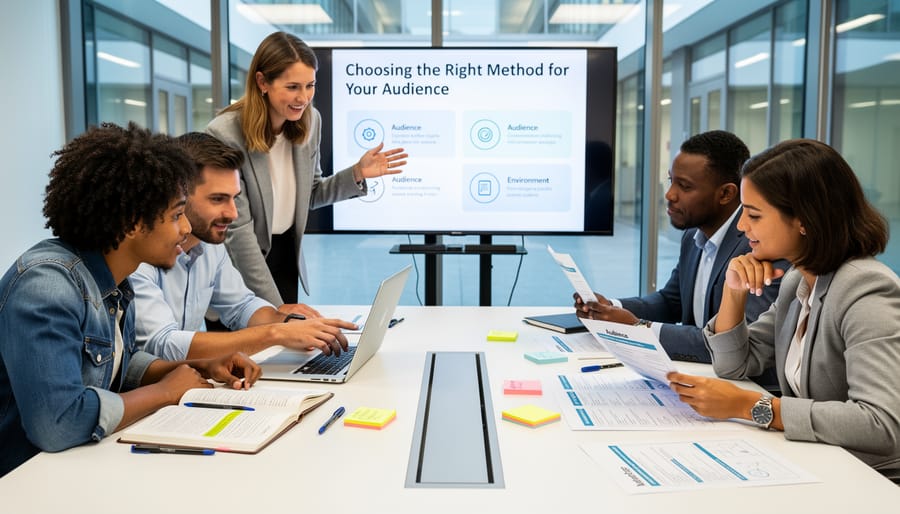
Step 1: Align Method with Learning Objectives
Start by identifying the cognitive level your learning objective targets, then select an instructional method that naturally supports that level of thinking. Bloom’s taxonomy offers a reliable map: knowledge and comprehension objectives call for direct instruction, lectures, readings, or video demonstrations that introduce foundational concepts. If you’re training new hires on compliance policies or teaching basic software navigation, a structured presentation followed by knowledge checks works well.
Application and analysis objectives require learners to use information in new contexts or break down complex ideas. Here, case studies, simulations, and guided problem-solving exercises prove more effective. A corporate training scenario might ask learners to diagnose a customer service issue using decision trees, while an academic context could involve analyzing primary sources to identify patterns. These methods push learners beyond recall into active thinking.
Evaluation and creation, the highest taxonomy levels, demand open-ended instructional methods. Project-based learning, peer critiques, design challenges, and capstone assignments let learners synthesize knowledge and generate original solutions. For instance, asking instructional designers to develop a training module for a real business problem exercises both evaluation (assessing needs) and creation (building the solution).
Match method to taxonomy level, not the other way around. Forcing a lecture to teach critical thinking or using a complex simulation to introduce vocabulary wastes time and frustrates learners.
Step 2: Match Method to Learner Characteristics
Once you understand your learning objectives, the next decision point is your learners themselves. A method that works brilliantly for experienced professionals will fall flat with novices, and a self-paced module that suits independent learners may frustrate those who thrive on group interaction.
Start by assessing experience level. Beginners need more structure, guided practice, and frequent check-ins, direct instruction or scaffolded activities work well here. Experienced learners often benefit from problem-based or collaborative methods that let them apply existing knowledge and learn from peers. If your audience spans both, consider tiered pathways or blended approaches that offer choice within guardrails.
Next, evaluate digital literacy and access. A highly interactive simulation or breakout-room collaboration assumes learners can navigate the tools confidently. If your audience includes those with limited tech skills or inconsistent connectivity, opt for simpler delivery formats like downloadable resources, asynchronous discussion boards, or instructor-led sessions with minimal platform switching.
Time availability is equally critical. Busy professionals rarely complete hour-long modules in one sitting, microlearning or just-in-time resources fit their workflow better. Learners with dedicated training time can handle synchronous workshops or deeper self-paced courses. Finally, consider social preference. Introverts and remote workers may prefer individual reflection and self-directed learning, while extroverts and on-site teams often engage more in collaborative, synchronous formats. Match method to these realities, not to what sounds innovative on paper.
Step 3: Select Delivery Tools and Platforms
Once you know which instructional method suits your objectives and learners, match it to the right technology stack. For blended learning, you need an LMS that supports asynchronous content delivery, progress tracking, and seamless integration with live sessions, look for a video conferencing LMS if your design includes synchronous instructor-led components. Peer learning and collaborative methods require discussion boards, breakout rooms, or tools like Slack, Microsoft Teams, or Miro for real-time co-creation. Experiential and simulation-based methods depend on specialized software, virtual labs, branching scenario builders, or immersive platforms that replicate real-world tasks. Problem-based learning benefits from case repositories, multimedia content libraries, and annotation tools that let learners mark up documents and share insights. Microlearning calls for mobile-responsive delivery, push notifications, and bite-sized content modules hosted on platforms designed for just-in-time access. Check that your chosen platform integrates with your existing tech ecosystem (SSO, HR systems, reporting tools) to avoid friction during rollout and ensure data flows where you need it for measurement.
Step 4: Design Learning Activities and Content
Once you’ve selected a method and mapped it to your learners’ needs, the next challenge is creating content that brings that method to life. Start by identifying the core knowledge or skill outcome, then reverse-engineer the activity format. For problem-based learning, develop realistic case studies drawn from your learners’ work context, use actual data sets, anonymized client scenarios, or industry-specific challenges that require analysis and decision-making. Structure the case with enough ambiguity to provoke critical thinking, but provide sufficient background detail for learners to anchor their reasoning.
For role-play or experiential methods, script scenarios that mirror high-stakes or frequent interactions your learners face: customer objections, performance conversations, crisis response, or negotiation. Include character profiles, situational context, and decision points. Test your scripts with a pilot group to ensure they feel authentic, not contrived.
Collaborative learning demands well-crafted discussion prompts that spark debate or synthesis, not simple recall. Frame questions around real problems, conflicting viewpoints, or application dilemmas. For microlearning, chunk content into single-concept modules, three to five minutes each, paired with a quick knowledge check or job aid. Focus on one actionable takeaway per module, stripping out all supporting detail that doesn’t directly serve immediate application.
Always curate supporting resources, articles, videos, templates, that learners can access on demand, and ensure all content aligns with your defined learning objectives from Step 1.
Step 5: Pilot, Gather Feedback, and Refine
Before you deploy a new instructional method across your entire learner population, run a controlled pilot with a small, representative cohort. This trial phase allows you to surface issues, validate assumptions, and refine your approach without risking large-scale failure or wasted resources.
Start by recruiting 10-30 learners who mirror your target audience in experience level, role, and digital literacy. Clearly communicate that this is a pilot, and their honest feedback will shape the final version. Set specific success criteria upfront: define what “working” looks like, whether that’s 80% task completion, positive satisfaction scores, or observable skill application.
- Select a pilot group that represents your full audience demographics and learning contexts
- Define 3-5 measurable success metrics tied to your learning objectives (completion rate, assessment scores, time-to-competency)
- Run the session or module exactly as planned, but build in observation checkpoints to note where learners struggle or disengage
- Collect both quantitative data (quiz scores, time spent, drop-off points) and qualitative feedback (open-ended surveys, brief interviews, chat logs)
- Analyze results to identify friction points: confusing instructions, mismatched pacing, technical barriers, or gaps in scaffolding
- Make targeted adjustments to content, activities, or delivery tools based on themes in the feedback, not isolated complaints
After revisions, consider a second small-scale test if the changes were substantial. This iterative cycle catches design flaws early, when they’re cheap to fix, and builds confidence that your method will perform when scaled. Formative evaluation isn’t optional, it’s the difference between guessing and knowing your instructional method works.
Key Instructional Methods and When to Use Them
Direct instruction remains foundational when introducing new concepts or technical skills. This teacher-centered approach delivers structured content through lectures, demonstrations, or guided practice. Use it when learners need explicit guidance before independent application, onboarding programs, compliance training, or foundational software tutorials benefit from this clarity. The method works best for knowledge acquisition and basic comprehension. Implementation tip: pair direct instruction with immediate practice opportunities and quick knowledge checks to reinforce retention.
Collaborative learning shifts authority to the learner group, leveraging peer interaction to build understanding. Assign team projects, peer reviews, or group problem-solving exercises when your learning objectives include communication skills, critical thinking, or knowledge synthesis. Discussion forums breakout rooms in virtual sessions, and shared documents enable asynchronous and synchronous collaboration. This method suits experienced learners who bring diverse perspectives but requires clear roles, deadlines, and facilitation to prevent unequal participation.
Problem-based learning presents authentic challenges that learners must research, analyze, and solve. Use it for intermediate to advanced learners tackling complex, real-world scenarios, case studies in leadership development or troubleshooting exercises in technical training. This method develops analytical skills and application but demands significant time investment and instructor support during the inquiry process.
Experiential learning immerses learners in doing rather than observing. Simulations, role-plays, and hands-on practice apply when the goal is skill mastery or behavior change. Customer service scenarios, crisis management simulations, or equipment operation training all benefit from this approach. Budget adequate time for reflection and debriefing after the experience to solidify learning.
Blended learning combines online and in-person elements, offering flexibility without sacrificing interaction. Deploy it when you need scalability alongside accountability, flipped classrooms where learners review content independently before live application sessions, or hybrid programs mixing eLearning modules with workshop days. This method supports diverse schedules and learning paces while maintaining engagement.
Microlearning delivers focused content in short bursts, typically under ten minutes. Use it for just-in-time support, refresher training, or ongoing skill development. Mobile-friendly modules covering single procedures or quick reference guides fit workflows where learners access information retrieval as needed rather than sitting through lengthy courses.
Adaptive learning uses technology to personalize content pathways based on individual performance and preferences. Implement it when your audience varies widely in baseline knowledge or when you need efficiency at scale. Adaptive platforms adjust difficulty, sequence, and reinforcement automatically, making them valuable for foundational skills training across large, diverse teams.
How to Measure Success and Validate Your Choice

Validating your instructional method requires tracking metrics across three tiers: immediate learner response, knowledge acquisition, and real-world application. Start with foundational KPIs from your LMS, completion rates, assessment scores, time on task, and progression through modules. These numbers reveal whether learners engage with the material and grasp the core concepts. Pair quantitative data with qualitative feedback through post-training surveys asking learners to rate relevance, clarity, and confidence in applying new skills.
The most critical validation happens weeks or months after training when you measure behavior change and business impact. Survey managers to assess whether learners apply new techniques in their daily work. Track performance metrics tied to your original learning objectives, such as reduced error rates, faster task completion, or improved customer satisfaction scores. If learners complete training but don’t change their practice, the instructional method likely doesn’t match their workflow or lacks sufficient scaffolding.
Use adaptive practice testing analytics to identify specific knowledge gaps and engagement drop-off points. When completion rates fall below 70%, assessment scores plateau under target thresholds, or post-training surveys reveal confusion, don’t double down, pivot. Supplement lecture-based methods with collaborative activities, add microlearning reinforcements to complex courses, or introduce peer coaching for skills requiring practice. Validation is ongoing, not a one-time checkpoint.
Frequently Asked Questions
Can you combine different instructional methods in a single program, or does mixing approaches dilute effectiveness? How do you decide which method fits a remote team versus an in-office cohort? And when a training mandate arrives with tight deadlines and zero flexibility, is there one method that reliably delivers results?
These are the questions eLearning professionals and corporate trainers ask when translating theory into practice. Here are answers grounded in real-world application and current learning design principles.
Can I use multiple instructional methods in one course?
Yes, and blending methods often produces better outcomes than relying on a single approach. For example, you might open with microlearning modules for foundational knowledge, follow with problem-based group activities for application, and close with a practical simulation for skill verification. The key is ensuring each method serves a distinct learning objective rather than duplicating effort.
How do I choose between synchronous and asynchronous methods?
Consider your learners’ time zones, schedules, and the need for real-time interaction. Synchronous methods (live sessions, virtual workshops) work well for collaborative problem-solving, immediate feedback, and relationship-building. Asynchronous methods (self-paced modules, discussion boards) suit learners balancing irregular work demands or needing time to reflect before contributing. Many successful programs use both, asynchronous prep work followed by synchronous application sessions, to maximize flexibility and engagement.
What instructional method works best for compliance training?
Compliance training typically benefits from direct instruction paired with scenario-based practice and knowledge checks. Start with clear, concise explanations of policies and regulations, then present realistic decision scenarios where learners apply the rules. Track completion rates and quiz performance to verify comprehension, and provide just-in-time refreshers rather than annual marathon sessions.
How do I adapt instructional methods for global audiences with different learning cultures?
Begin by researching cultural attitudes toward authority, collaboration, and public participation, what works in a North American peer-learning environment may feel uncomfortable in cultures that prioritize deference to expert instruction. Offer multiple pathways: provide both group discussion options and individual reflection assignments, allow learners to choose between vocal participation and written contributions, and use diverse examples that resonate across regions. Pilot with representative learners from each geography and adjust based on their feedback before full rollout.
Another common concern: whether one method consistently outperforms all others. The answer is no. Effective instruction is contextual, not universal. Lecture-based methods can efficiently deliver procedural knowledge to experienced professionals who need updates, while experiential methods might frustrate beginners who lack the foundational schema to learn through exploration. Your choice should reflect the intersection of learning objective, audience readiness, and organizational constraints, not a trend or a personal preference.
Selecting the right instructional method isn’t a one-time decision, it’s an ongoing commitment to improving how people learn. By following the step-by-step process outlined in this guide, you ensure that every choice aligns with your learners’ needs, your objectives, and the resources available. Start with clear goals, match methods to your audience, test and refine, and measure what matters. Each iteration sharpens your approach and deepens your understanding of what works in your context.
Effective teaching evolves alongside your learners, your technology, and your organizational priorities. What succeeds today may need adjustment tomorrow as roles shift, tools improve, or feedback reveals new friction points. Treat instructional method selection as a dynamic practice, not a fixed formula. Experiment with new approaches, track results, and stay curious about emerging strategies that can enhance engagement and retention.
The profession’s dedication to this evolution is evident in events like World Teachers’ Day on October 5, 2026, and professional development opportunities such as the Beginning Teachers Conference in Calgary, held October 2-3, 2026. These gatherings reflect a shared commitment to refining teaching practices and supporting educators at every stage.
Your role as an instructional designer or trainer is to make intentional, evidence-backed decisions that drive real learning outcomes. Keep testing, keep measuring, and keep adapting. The most effective instructional methods are the ones you choose deliberately and improve continuously.