

A graduate project management certificate is a specialized credential designed to equip professionals with advanced project execution skills without requiring a full master’s degree, typically completed in 12 to 18 months through coursework in frameworks, risk management, budgeting, and stakeholder communication. For eLearning and L&D professionals, this certificate addresses a critical gap: the ability to design exceptional training content while lacking the structured methodology to deliver complex implementations on time and within scope.
The rise of this credential reflects a broader shift in how organizations view learning and development roles. Corporate training projects now involve cross-functional teams, enterprise-wide technology rollouts, and measurable ROI expectations that extend far beyond instructional design. When you’re managing a learning management system migration, coordinating subject matter experts across multiple departments, or rolling out compliance training to thousands of employees, traditional L&D expertise alone often falls short.
These graduate certificates differ from entry-level Project Management Professional (PMP) training or online bootcamps by offering university-backed academic rigor combined with practical application. Programs typically include advanced coursework in program portfolio management, organizational change, and strategic alignment, topics that resonate directly with senior-level L&D practitioners navigating digital transformation initiatives.
The value proposition centers on credibility and capability. For professionals already holding instructional design degrees or certifications, adding formal project management credentials signals a hybrid skill set increasingly demanded by organizations that recognize training development as a strategic function requiring both pedagogical expertise and operational discipline. The question for most eLearning professionals isn’t whether project management skills matter, but whether pursuing a graduate certificate offers sufficient career acceleration compared to shorter alternatives or self-directed learning paths.
The Convergence of Learning Design and Project Management

Learning design and project management once occupied separate professional spheres. Instructional designers focused on pedagogy, learner engagement, and content architecture. Project managers handled timelines, budgets, and resource allocation. That division no longer reflects reality in corporate L&D environments.
Modern learning initiatives have evolved into multi-phase operations involving cross-functional teams, technology integrations, stakeholder alignment, and phased rollouts. Developing a comprehensive onboarding program now requires coordinating subject matter experts, graphic designers, video producers, LMS administrators, and departmental stakeholders across months of iterative development. Migrating to a new learning platform touches IT infrastructure, content migration, user training, and change management. These aren’t side projects handled through email threads. They’re complex undertakings that fail without structured execution frameworks.
The instructional design process itself mirrors project phases. Analysis, design, development, implementation, and evaluation follow a predictable sequence requiring milestone tracking, resource planning, and risk mitigation. Yet most eLearning professionals receive extensive training in ADDIE or SAM methodologies without learning how to manage the organizational mechanics that determine whether their designs actually launch on time and within budget.
This expertise gap creates real problems. L&D teams miss deadlines because scope creep goes unmanaged. Budgets overrun when no one tracks resource consumption against deliverables. Stakeholders disengage when communication lacks structure. Discussion forums and collaborative course elements get cut from projects not because they lack instructional value, but because timeline pressure forces compromises that wouldn’t occur with proper project planning.
The business side of organizations increasingly views training initiatives through a project lens, measuring success by completion rates, time to competency, and return on learning investment. When executives ask about project status, they expect answers framed in deliverables and risk assessments, not learning objectives. This disconnect leaves instructional designers struggling to communicate value in terms leadership understands.
Formal project management training addresses this misalignment by equipping L&D professionals with frameworks for scope definition, stakeholder management, and risk assessment that complement their design expertise. It transforms capable instructional designers into learning leaders who can both create effective training and ensure its successful delivery within organizational constraints.
What Defines a Graduate Project Management Certificate
Core Curriculum Components

Most graduate project management certificate programs structure their curriculum around five to seven core courses that form the foundation of professional project execution. While universities vary their specific course titles, the content areas remain remarkably consistent across accredited programs.
Project planning courses teach you to develop comprehensive project charters, define scope boundaries, create work breakdown structures, and build realistic schedules using critical path methodology. You’ll learn to translate abstract learning objectives into measurable deliverables with clear timelines, essential when stakeholders ask whether a compliance training rollout can happen in six weeks instead of twelve.
Risk management modules focus on identifying potential threats to project success before they materialize. For eLearning professionals, this means anticipating SME availability issues, technology compatibility problems, or scope creep from stakeholders requesting additional features mid-development. You’ll learn quantitative and qualitative risk analysis techniques, then practice building mitigation strategies and contingency plans.
Budgeting and resource allocation courses cover cost estimation, financial tracking, and earned value management. These skills directly address the reality that most L&D teams face budget scrutiny. You’ll learn to justify technology investments, track development hours against projections, and demonstrate project ROI to finance teams.
Stakeholder management training teaches communication strategies for diverse audiences, from executive sponsors to end users. Agile methodologies courses introduce sprint planning, retrospectives, and iterative development cycles, increasingly relevant as learning teams move away from waterfall approaches toward rapid prototyping and continuous improvement models. Many programs now include modules specifically addressing hybrid project frameworks that blend traditional and agile methods for complex organizational initiatives.
Academic vs. Professional Credentials
Understanding the difference between these credentials prevents confusion and helps you choose the right path for your career goals.
Academic graduate certificates come from accredited universities as part of their formal degree programs. You earn academic credit, receive a transcript, and the credential appears on your permanent university record. These typically require 12-18 credit hours of graduate-level coursework. They can often ladder into a master’s degree if you choose to continue, with credits transferring directly. Universities issue these certificates upon completion of specific coursework with passing grades.
Professional certifications like the PMP or CAPM come from industry bodies such as the Project Management Institute. They require passing a standardized exam, meeting experience prerequisites, and maintaining the credential through continuing education. No academic credit is involved, and they focus on demonstrating competency against established practice standards rather than completing coursework.
The two complement each other strategically. A graduate certificate provides the theoretical foundation and structured learning environment, while professional certifications validate your practical knowledge and signal industry-recognized competency. Many eLearning professionals pursue both: the graduate certificate builds comprehensive skills during career transitions, and later certification proves mastery to employers and clients.
Neither replaces the other. They serve different purposes in your professional development portfolio.
Why eLearning Professionals Are Pursuing PM Credentials Now
The shift toward formal project management credentials among eLearning professionals isn’t happening in a vacuum. Three converging forces are driving this trend in 2026: the scale and complexity of modern learning initiatives have outgrown informal project coordination, organizations are demanding measurable ROI from L&D investments, and leadership roles in learning now explicitly require project management competency.
Learning projects today involve cross-functional teams that instructional designers never historically managed. A corporate training initiative might include subject matter experts from operations, compliance officers, IT infrastructure teams, third-party vendors, legal reviewers, and regional implementation leads across multiple time zones. The instructional designer who could once focus purely on pedagogy and content now finds themselves coordinating dependencies, managing timelines, and reporting status to executives who speak in project management terminology.
Budget accountability has become non-negotiable. Finance departments increasingly expect L&D teams to provide project plans with resource allocation, timeline estimates, and risk assessments before approving initiatives. The instructional designer who responds with a vague timeline and a rough cost estimate loses credibility and funding. Organizations want learning leaders who can demonstrate PM rigor: tracking actuals against estimates, managing scope creep, and explaining variances in business terms.
The complexity of modern eLearning projects demands formal PM frameworks. Consider the range of initiatives where project management skills prove critical:
- LMS implementations involving data migration, integration testing, and phased user rollouts
- Curriculum overhauls requiring stakeholder alignment, sequential content development, and pilot testing
- Compliance training rollouts with fixed regulatory deadlines and audit documentation requirements
- Vendor management for content development, technology platforms, and consulting services
- Multi-stakeholder initiatives coordinating executive sponsors, regional teams, and external partners
These scenarios expose the gap between instructional design training and execution capability. An instructional designer understands learning theory and content development but may struggle with resource leveling, critical path analysis, or risk mitigation planning.
Career advancement creates the final pull factor. L&D leadership positions now list project management as a required competency, not a nice-to-have skill. Job descriptions for learning directors and heads of training explicitly mention PMP certification, Agile experience, or project management education. Professionals who want to move beyond individual contributor roles recognize that a graduate certificate provides both the skills and the credential to compete for these positions.
The graduate certificate answers all three pressures simultaneously. It provides the formal methodology organizations demand, the execution skills complex projects require, and the credential that opens leadership opportunities. For eLearning professionals watching colleagues struggle with project chaos or seeing management positions go to candidates with PM backgrounds, the decision to pursue formal credentials becomes strategic rather than optional.
How to Evaluate Graduate Certificate Programs for eLearning Careers
Questions to Ask Before Enrolling
Before investing time and tuition in a graduate certificate program, ask pointed questions that reveal whether it aligns with your eLearning career trajectory. These aren’t generic admission inquiries, they’re strategic filters that separate programs built for digital project realities from those still teaching traditional construction or manufacturing PM frameworks.
- What percentage of faculty have led digital learning projects or technology implementations in corporate or educational settings?
- Does the curriculum include case studies or simulations based on instructional design workflows, LMS rollouts, or virtual training programs?
- Will I build a portfolio that demonstrates PM competency in learning contexts, or does assessment rely solely on exams and papers?
- Which organizations currently hire your graduates specifically for L&D or training project management roles?
- Do corporate partners provide mentorship, capstone project sponsorship, or job placement pipelines into learning functions?
- What resources remain accessible after completion, career coaching, alumni networks, continuing education, or PMI exam prep support?
Request concrete examples when programs claim “industry connections” or “practical focus.” A partnership with a construction firm matters less than relationships with ed-tech companies, corporate universities, or organizations known for sophisticated higher education online learning initiatives. Ask to speak with alumni working in L&D roles, their career paths post-graduation reveal more than any marketing materials.
Pay attention to how programs handle asynchronous learning experiences, since you’ll likely balance coursework with instructional design deadlines. Programs that understand digital project workflows typically offer flexible scheduling that mirrors the realities of eLearning development cycles.
Applying PM Frameworks to Learning Development Projects
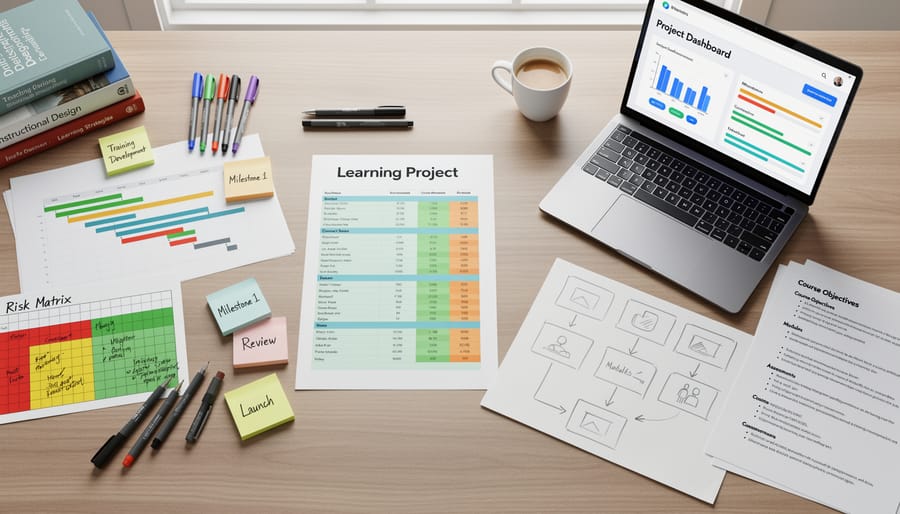
Traditional project management frameworks aren’t abstract theories, they’re practical structures that directly solve the chaos most eLearning teams face daily. Understanding how Waterfall, Agile, and hybrid methodologies map onto learning projects transforms scattered development efforts into predictable, quality outcomes.
Waterfall’s sequential phases, initiation, planning, execution, monitoring, closure, align naturally with large-scale course development where requirements are stable. When building compliance training with fixed regulatory content, you need comprehensive upfront analysis and design before development begins. Each phase gate (stakeholder sign-off on objectives, then storyboards, then prototypes) prevents expensive rework later. The structure forces crucial conversations about learning outcomes and success metrics before your team writes a single line of code or records any videos.
Agile methodologies shine in dynamic learning environments where requirements evolve. Breaking a leadership development program into two-week sprints lets you deliver functional modules iteratively, gathering learner feedback that shapes subsequent releases. Daily standups keep distributed instructional designers and developers synchronized. Sprint retrospectives surface process bottlenecks, maybe your SME review cycle consistently delays every iteration, allowing continuous improvement. The iterative approach particularly suits emerging topic areas where you’re discovering what learners need as you build.
Complex initiatives demand hybrid approaches that blend both methodologies strategically. Google-to-LMS migrations typically follow Waterfall’s structured planning for technical infrastructure and data migration while using Agile sprints for user training development and adoption campaigns. You can’t iterate on database architecture decisions, but you absolutely should refine training content based on pilot group feedback.
Training program launches benefit from phased Waterfall rollout planning combined with Agile content refinement. Establish your deployment timeline, stakeholder communication plan, and success metrics using Waterfall’s clarity. Simultaneously, run Agile cycles developing supporting resources, job aids, microlearning modules, facilitator guides, that respond to early adopter questions and pain points.
Technical implementations like adding LMS video conferencing capabilities require Waterfall’s risk management and vendor coordination while maintaining Agile flexibility for feature prioritization based on instructor feedback during pilot testing.
The framework you choose matters less than deliberately choosing one and applying its discipline consistently. Graduate PM certificates teach you how to match methodology to project characteristics, scope stability, team distribution, stakeholder involvement patterns, technical complexity, rather than defaulting to whatever your team has always done. That diagnostic skill alone justifies the credential investment.
The ROI Argument for Your Organization
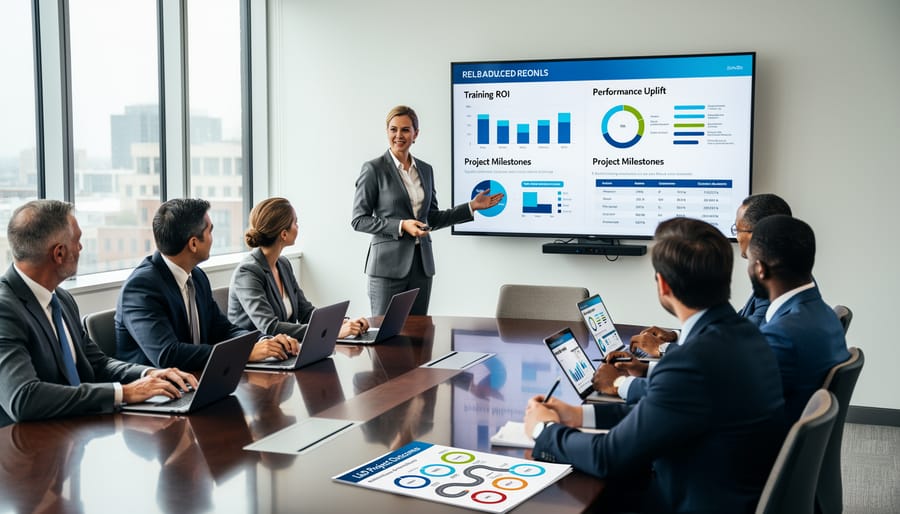
When you approach leadership about funding your graduate project management certificate, frame it as an investment in organizational capability, not personal development. Start with the immediate pain points they already feel: delayed course launches, scope creep in training initiatives, and learning projects that consistently run over budget. A certificate program equips you to directly address these issues through structured methodologies that bring predictability to L&D operations.
The financial case is stronger than it first appears. While program costs typically range from $5,000 to $15,000, compare that against a single failed learning initiative. A corporate training program that misses its launch window, exceeds budget by 40 percent, or delivers course completion rates below 30 percent can cost your organization tens of thousands in wasted investment and lost productivity. One well-managed project can recoup the certificate cost.
Present the time investment honestly. Most programs require 12 to 18 months at 8 to 12 hours weekly. The key argument: you’ll apply frameworks immediately to active projects, creating real-time ROI. Your current LMS implementation becomes a capstone-quality case study. Your next compliance training rollout tests agile sprint planning in practice. Leadership sees improvement while you’re still enrolled, not two years later.
Pros
- Apply new methodologies to live projects immediately, creating measurable improvements during your studies.
- Build formal credentials that position you for L&D leadership roles requiring budget and team oversight.
- Gain frameworks that reduce project delays and cost overruns across your entire portfolio.
- Connect with cohort peers managing similar learning initiatives, expanding your professional network.
Cons
- Requires 8 to 12 weekly hours alongside full-time work, demanding strong personal time management.
- Initial productivity dip likely during semester peaks when assignments and projects converge.
- Upfront cost creates budget hurdles if your organization lacks professional development funding.
- Benefits accumulate gradually rather than delivering immediate transformation in first months.
Quantify the organizational benefits in terms your CFO understands. Reduced project timelines mean faster time-to-impact for training initiatives. Improved risk management decreases the likelihood of compliance gaps. Standardized processes create repeatability, allowing your team to handle higher project volume without proportional headcount increases. Position yourself as building infrastructure that scales beyond your individual contribution, and suddenly you’re discussing strategic capability, not tuition reimbursement.
Frequently Asked Questions About Graduate PM Certificates for eLearning Professionals
Do I need prior project management experience to enroll?
Most graduate certificate programs accept students with diverse professional backgrounds. Universities typically require a bachelor’s degree and relevant work experience, but you don’t need formal PM credentials. Your instructional design or training development work counts as project experience. Some programs prefer 2-3 years of professional experience, which most eLearning practitioners already have.
How do I balance certificate coursework with a full-time instructional design role?
Graduate certificates are designed for working professionals. You’ll typically take one or two courses per semester, with most programs offering fully online or evening formats. The workload averages 10-15 hours weekly per course. Many eLearning professionals find the timing works well because they can immediately apply concepts to current learning projects, making the studies feel less like additional work and more like structured skill development.
Will this certificate qualify me to sit for the PMP exam?
Not directly. The PMP requires specific project management education hours and documented project leadership experience. However, certificate coursework often fulfills the 35 contact hours of PM education required for PMP eligibility. You’ll still need to demonstrate sufficient hours leading projects, but the certificate provides both the educational foundation and practical experience to pursue PMP certification afterward if you choose.
What’s the typical cost range?
Graduate certificate programs generally cost between $6,000 and $15,000 total, depending on the institution and program length. Public universities typically charge less than private institutions. This is substantially lower than master’s degree programs, which often exceed $30,000. Some employers offer tuition reimbursement for job-relevant credentials.
How does this compare to a master’s in instructional design or learning technologies?
They serve different purposes. Learning design master’s programs deepen your understanding of pedagogy, learner psychology, and design frameworks. PM certificates focus exclusively on execution skills: planning, budgeting, risk management, and delivery. If you’re strong in design but struggle with project delivery, the PM certificate addresses that specific gap more efficiently and affordably than a full master’s degree.
Project management graduate certificates represent more than professional development, they signal a fundamental shift in how organizations value L&D leadership. As learning initiatives grow in complexity and stakes, the gap between instructional expertise and execution capability becomes harder to ignore. Professionals who bridge that gap with formal PM credentials position themselves as strategic contributors, not just course creators.
The trend remains niche enough that early adopters gain competitive advantage. While eLearning master’s programs proliferate and PMI certifications saturate the broader market, graduate certificates specifically tailored to project execution occupy a sweet spot: rigorous enough to demonstrate commitment, focused enough to apply immediately, and recognized enough to open doors in L&D leadership conversations.
The landscape will continue demanding more from learning professionals. Budgets tighten, timelines compress, stakeholder expectations rise. The instructional designers who thrive won’t just create excellent learning experiences, they’ll deliver them on time, within budget, with measurable results and documented processes. Formal PM training accelerates that capability.
If you’re considering this path, start with program research aligned to your specific eLearning context. Talk to your leadership about organizational support before you enroll. Map how the credential fits your five-year career trajectory, not just immediate skill gaps. The investment matters most when it serves both your growth and the real problems your organization needs solved.